Theravada Buddhism Classes
No one saves us but ourselves. No one can and no one may. We ourselves must walk the path.
Deprived of a systematic knowledge about early Buddhism, some get stuck in illusion, and some have many questions. Only a teacher who has learned Buddhism in a systematic way and practiced it for some time can help the curious learner and answer the questions.
Class attendance will be marked, and a certificate of completion will be issued at the end of the course. College and university students are also encouraged to attend.
Students will get a copy of the syllabus on the first day of the class. This is a rare opportunity to learn all the fundamental teachings of Theravada Buddhism.
The course starts Saturday, January 13th, and ends on Saturday, April 28th. It is conducted in English and is free of charge.
Every Saturday 4:00pm – 6:00pm
This series is completed as of May 2018. please see the recordings and materials below.
January
February
March
April
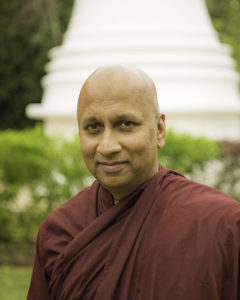
Bhante Upananda is a fully ordained Buddhist monk, originally from Sri Lanka. He holds Master’s Degrees in Religion, from the University of Cambridge, UK, and from Florida International University. He did his Bachelor’s Degree in Pali, which is the canonical language of Theravada Buddhism. Bhante is also a child, youth, and family guidance counselor, and an instructor in mindfulness meditation. He has taught Buddhism and World Religion in Sri Lanka, Singapore, Malaysia, Canada, and in the United States. He also has vast experience in teaching mindfulness meditation at law enforcement agencies in the US.